Do you have any of these symptoms?
- You can run a same-store-sales report from corporate, but you can't easily pull a list of which families haven't visited in 60 days.
- You know roughly which ZIPs your customers come from, but you can't answer which high-kid-density ZIP nearby you have almost no customers in — the dark spots that should be eating your ad spend.
- Birthday parties are your highest-margin product, but you have no systematic way to reach the parents of kids turning 5, 6, 7 before they book somewhere else.
- Your membership program leaks. Members pay this month but stop visiting, then cancel two months later, and you only find out when the cancel email hits your inbox.
- Every time you want to run a marketing campaign — birthday outreach, member win-back, lapsed-VIP push — you're stuck exporting from the POS, joining in Excel, dedup'ing by phone, then pasting into Mailchimp. It takes a day. You only do it twice a year.
If two or more of those rang true: you're not alone. This is the default experience for every Urban Air operator we've talked to.
The pattern
Your park generates rich data every single day — waivers, scans, party bookings, memberships, POS transactions, payment history. Corporate aggregates a sliver of that into your back-office reports, but the raw signal stays trapped in their warehouse. You can see the totals. You can't see the people.
That gap — between the totals you're shown and the people you'd actually text — is where the leaks happen. Lapsed members you can't name. Birthday families you can't reach. ZIP codes you're not targeting because you don't know they exist as opportunities.
It's not your fault. No park owner has time to build an in-house data warehouse, hire a SQL analyst, run their own segmentation, and ship TCPA-compliant SMS. That's not the job you signed up for.
What Aria does
Aria is the missing data layer between your park and your marketing decisions. We plug into your existing POS and do three things:
1. We turn your park's data into a customer view.
One row per household. Identity, recency, frequency, membership status, party history, the kid's age, the kid's birthday. Joined and queryable for the first time.
2. We surface where you should be acting.
ZIP-level intelligence with three lenses — acquisition (where your customers come from), retention (who's drifting), and intelligence (the cross-cutting view). The dark spots — high-kid-density ZIPs you have almost no customers in — show up in red. That's where your next ad spend should go.
3. We run two plays that turn the data into outcomes.
The retention play. Three time-anchored SMS reminders to drifting families — 60-day soft nudge, 45-day personal reminder, 30-day last call. Proven cadence. Catches families before they're gone.
The acquisition play. Targets the dark-spot ZIPs with ad-ready segments and lookalike audiences your existing ad platform (Meta, Google) can ingest directly.
That's it. No new CRM for your staff to learn. No campaign builder for you to configure. No spreadsheets to maintain.
What you actually have to do
This is the part that surprises most operators.
Pay the invoice and give us your POS credentials. We do the rest.
No IT project. No staff training. No new tools on the front desk. Aria is a service, not a tool you operate. We pull the data, we build the segments, we send the texts, we route the replies. Setup takes about two days. You see the first SMS plays warmed up within 60 days.
If you want to send the texts yourself — using your own phone, your own SMS tool — that's fine, we'll deliver you the lists and segments and you take it from there. If you want us to handle the SMS layer end-to-end (TCPA compliance, opt-out handling, reply classification, deliverability), that's a separate $200/month package that includes 8,000 messages.
Either way, the data and intelligence layer is the same.
What you'd actually see in your dashboard
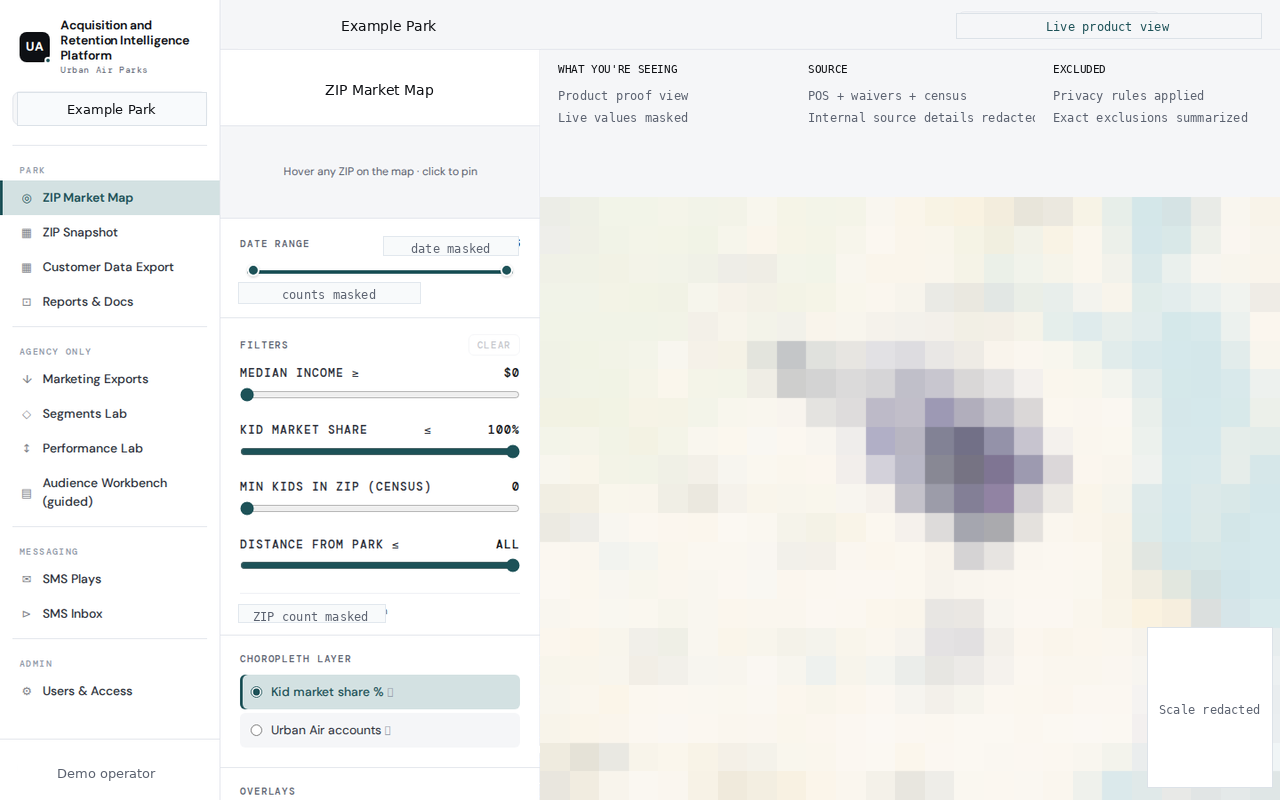
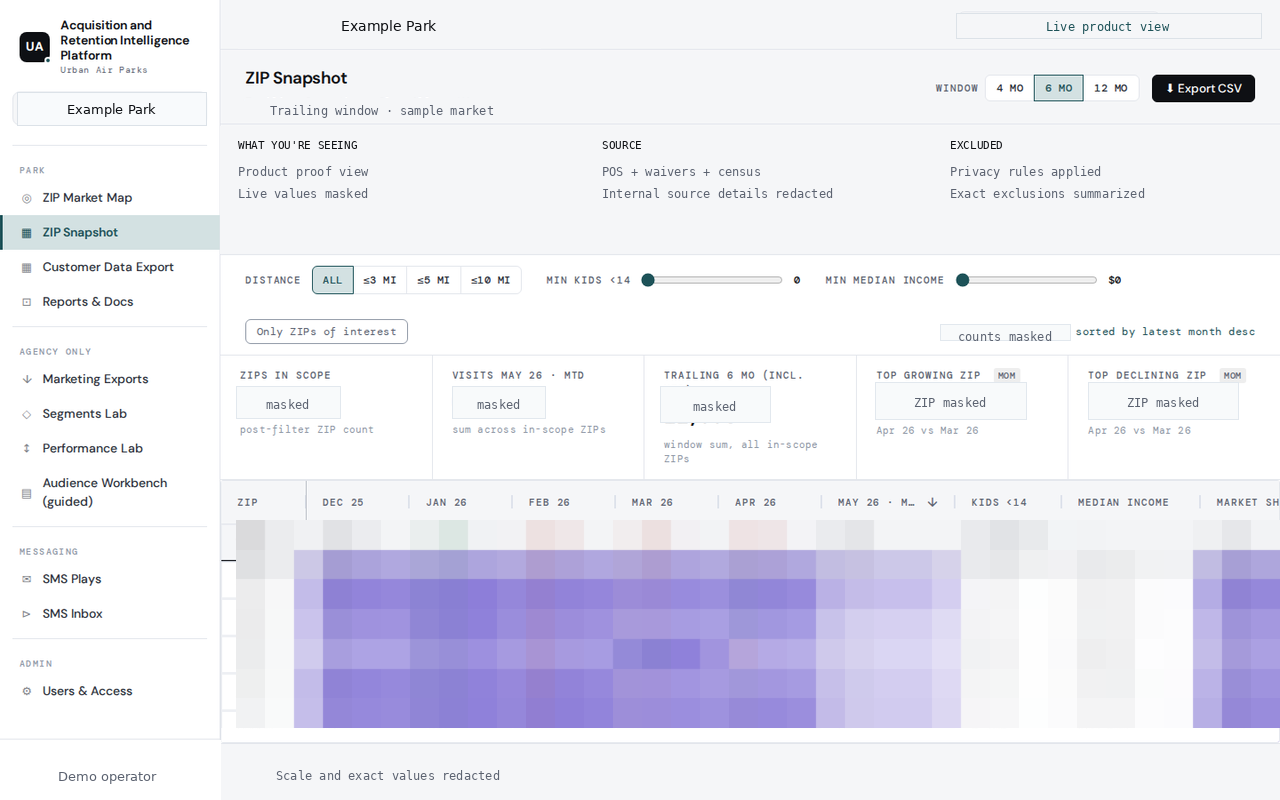
On a 20-minute call, we'd pull your park's real data and walk you through three views. We cannot show live customer data publicly for confidentiality reasons, so the screenshots below come from a real Aria operating lab for a Northeast-area Urban Air park with names, dates, counts, and ZIP-level values masked.
1. Your ZIP map (acquisition lens)
Every ZIP in your catchment, scored for households-with-kids density and weighted against your existing customer count. The dark-spot ZIPs — high opportunity, no existing reach — are where your next ad spend should go.
2. Your ZIP snapshot (retention & intelligence lens)
Per-ZIP detail on visits, customer counts, time-in-status, lifetime value, dollars per visit, and what's new vs. what's culled this period. The view where you spot the leaks before they turn into churn.
3. Month-by-month gains and losses
Aria also shows you which customer cohorts came back, which drifted, and which were caught by the 60/45/30-day retention cadence — month by month. Green is families re-engaged. Red is families lost to drift. (Illustrative — the actual visualization in your portal uses your park's real cohort data.)
Aria turns on in March; the gain bar (green) grows and the loss bar (red) shrinks as the 60/45/30-day cadence catches families before they're gone.
3. The plays running automatically
Below the data views, you'd see the two SMS plays in production — how many texts are scheduled this week, who they're going to, what they say, what's been sent, who replied, who opted out. You can pause any play at any time. Aria is your operator dashboard, not a black box.
The 60-day planning case
A useful Urban Air planning case asks whether your list, consent posture, offer, and follow-up rhythm can support:
- 1-2 extra birthday parties booked per week from a warm birthday outreach list.
- Consistent lapsed-family follow-up that would otherwise be skipped when the week gets busy.
- A clear dark-spot map showing the 5–10 ZIPs your next ad spend should target — and the ones you're currently over-spending in.
- At-risk member alerts — members who paid this month but haven't visited in 14 days, surfaced before they cancel, with a specific intervention prompted.
The number to test first: two extra parties a week x $600 average party invoice is about $5,200/month in scenario party revenue. That is not a guarantee; it is the planning case to believe or reject using your own list quality and consent reality.
What it costs
Aria is priced anchored to a unit your park already understands: the value of a party at your park.
At two extra parties a week, the scenario is about 8.7 parties per month. Aria Complete is priced at 1.5 parties per month, so the calculator shows what has to be true before the subscription clears its cost.
You can run the math against your own park's numbers here: aria.ussp.co/calculators/birthday
Why this is real
We do not publish customer names, exact locations, or live metrics. The proof here is the redacted product workflow: POS and waiver data joined into ZIP intelligence, birthday outreach, retention follow-up, and weekly actions an operator can use.
The next step: a 20-minute walkthrough
The right next step isn't an email back-and-forth — it's a quick call where we pull your park's actual data and walk you through what your dark-spot map looks like, who your at-risk members are this month, and what the 60-day plan would be.
Twenty minutes, your screen-sharing, no slides. We do all the prep — you just need to bring your POS login when the call starts. By the end you'll know whether Aria is worth a try or not.